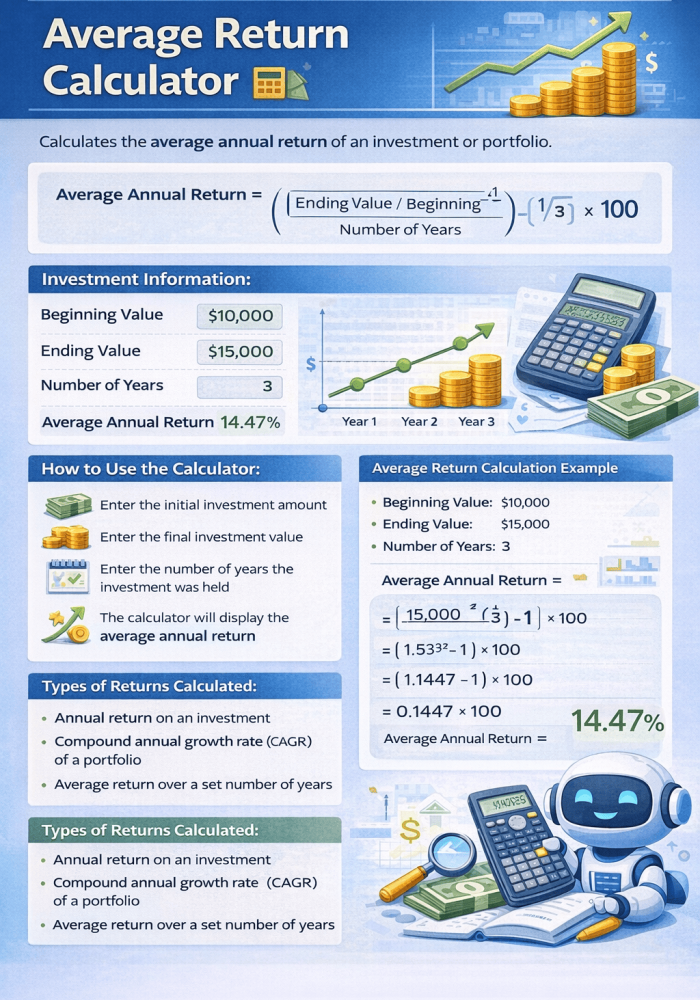
Average Return Calculator
Calculate average returns, compound annual growth rate (CAGR), and analyze investment performance. Compare different investment scenarios and visualize how your investments grow over time with various return assumptions.
Calculation Type
Investment Details
USD
USD
Years
Months
Periodic Returns
USD
Year
Annual Return (%)
Action
Year 1
Year 2
Year 3
Year 4
Year 5
Regular Investment Plan
USD
Years
%
USD
Advanced Settings
%
%
Return Analysis
💰
Total Investment
$10,000
📊
Final Value
$25,000
📈
CAGR
9.6%
Total Return
$15,000
Total Return %
150%
Annualized Return
9.6%
Average Return
10.0%
Adjusted Results
After Inflation
$18,242
After Taxes
$21,250
Real CAGR
6.9%
Real Return
$8,242
Investment Growth Over Time
Investment growth chart will appear here
Return Comparison
Return comparison visualization
Investment Insights
💡
Your investment would double in approximately 7.5 years at this growth rate
💡
This return outperforms the historical S&P 500 average of ~7% after inflation
💡
Consider dollar-cost averaging to reduce market timing risk
Export Results
Historical Market Returns
🇺🇸
S&P 500
9.8%
Annualized (1926-2023)
📈
NASDAQ
10.5%
Annualized (1971-2023)
🏛️
10-Year Treasury
4.8%
Average (1926-2023)
💰
Real Estate (REITs)
8.3%
Annualized (1972-2023)
🌍
Global Stocks
7.5%
Annualized (1970-2023)
🛡️
Gold
4.8%
Annualized (1971-2023)
Common Investment Scenarios
Conservative Growth
8.2% CAGR
Initial:
$10,000
10 Years:
$21,967
Risk Level:
Low
Moderate Growth
12.4% CAGR
Initial:
$10,000
10 Years:
$32,071
Risk Level:
Medium
Long-Term Growth
10% CAGR
Initial:
$10,000
20 Years:
$67,275
Risk Level:
Medium
Retirement Savings
7% CAGR
Monthly:
$500
30 Years:
$612,765
Risk Level:
Medium
Your Saved Scenarios
No scenarios saved yet. Calculate returns and click "Save Scenario" to store them here.
Understanding Investment Returns
CAGR vs Average Return
CAGR (Compound Annual Growth Rate) accounts for compounding, while simple average return doesn't. CAGR is more accurate for comparing investments over time.
The Power of Compounding
A 10% return for 20 years turns $10,000 into $67,275. Small differences in returns create huge differences over long periods.
Real vs Nominal Returns
Nominal returns don't account for inflation. Real returns subtract inflation to show actual purchasing power growth.
Volatility Matters
Two investments can have the same average return but different CAGRs if one has more volatility (sequence of returns matters).